
How High Should a Pendant Light Hang Over a Dining Table?

Updated: Aug 27
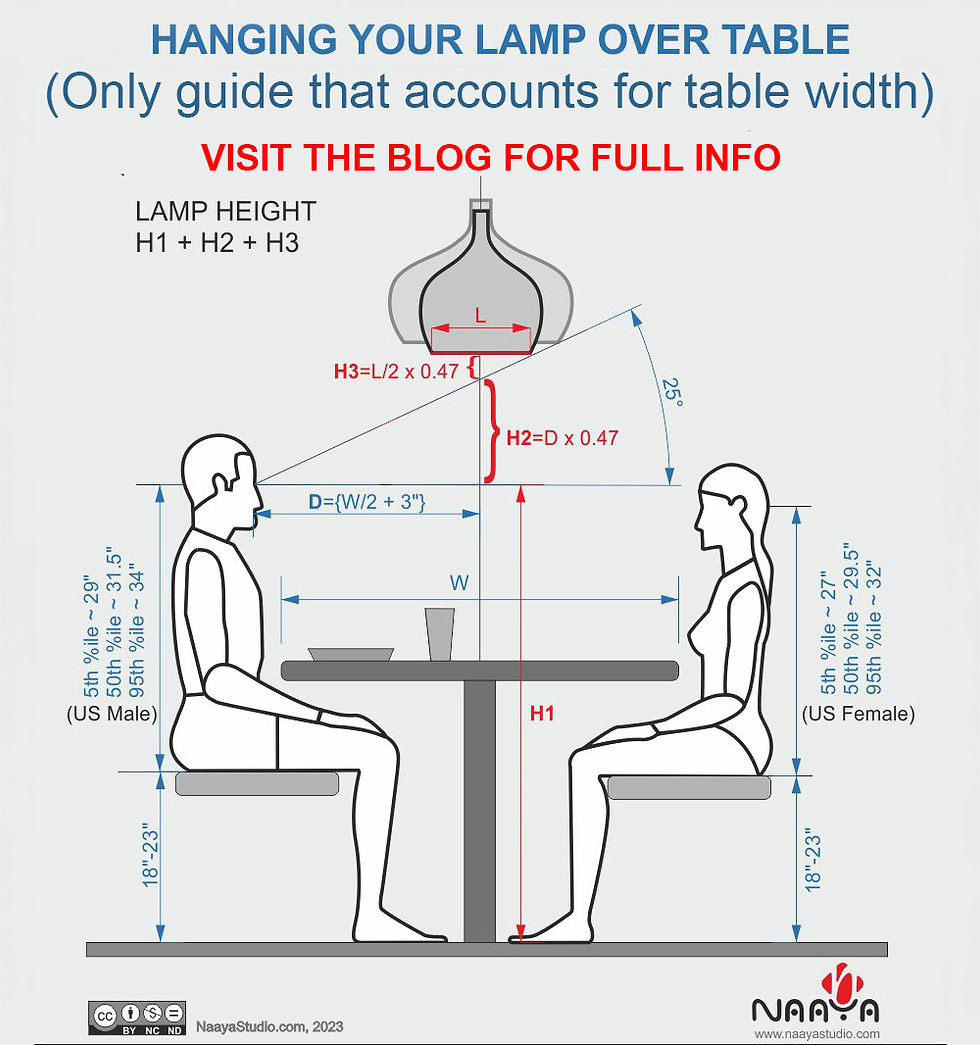
Short answer: For most dining tables, position the bottom of a pendant light 28-34 inches (70-85 cm) above the tabletop. This is a useful starting point, but it is not a universal measurement.
The ideal height can change depending on the table width, seated eye height, pendant opening and how the fixture sits within the user's line of sight.
This guide explains both the conventional 28–34 inch rule and a geometric approach you can use when a standard measurement isn't enough.
Quick Reference: Pendant Height Over a Dining Table
Table clearance: Start with 28–34 inches (70–85 cm) from the tabletop to the lowest point of the pendant.
Sightline: The pendant should not obstruct comfortable conversation or become a persistent visual obstruction when people are seated.
Fixture scale: As a general design starting point, a pendant's diameter can be around one-half to two-thirds of the table width, depending on the fixture and composition.
Table position: A centred pendant should be proportioned to the table rather than positioned solely according to ceiling height.
Why the Standard 28–34 Inch Rule Doesn't Work for Every Table
The 28–34 inch recommendation is a useful starting point, but it assumes a fairly typical combination of table, seating position and pendant size.
Real spaces vary.
A wider table changes the distance between the seated viewer and the pendant. A taller person has a higher seated eye level. And a large pendant opening can extend further into the visual field than a smaller fixture.
These factors can change the height at which the lowest point of the pendant should be positioned.
In practice, three variables can change the appropriate height:
The seated eye height of the user
The width of the table
The opening of the pendant
The Principle: Clear the Seated Line of Sight
When a pendant hangs over a dining table, its position should allow people seated opposite one another to see comfortably across the table without the fixture becoming a persistent visual obstruction.
For this calculation, we use an approximate 25° upward viewing angle as a practical geometric assumption. This gives us a way to estimate the required height rather than relying solely on a fixed rule.

Three Factors That Affect Pendant Height
The calculation depends primarily on three variables:
1. Seated eye height
The taller the regular user, the higher the fixture may need to be positioned to maintain the intended sightline.
2. Table width
A wider table changes the horizontal distance between the seated viewer and the centre of the pendant.
3. Pendant opening
A larger opening extends further into the relevant sightline and becomes increasingly important with larger fixtures.
In general:
Wider pendant opening → potentially higher fixture
Wider table → potentially higher fixture
Taller seated user → potentially higher fixture
The Ergonomic Pendant Height Formula
To determine the exact minimum clearance for the lowest point of your light fixture:
Lowest Point Height = H1 + H2 + H3
Where:
H1 (Sitting Eye Height): Height from floor to eye level when seated (typically 40–44 inches).
H2 (Table Width Factor): 1/4 x Table Width, based on the 25° viewing-angle assumption used in this guide.
H3 (Lamp Opening Factor): 1/4 x Shade Opening Diameter
How to Calculate Pendant Height
Step 1: Measure the Seated Eye Height
For a home, the simplest and most accurate approach is to have the tallest regular user sit at the table and measure from the floor to their eye level.
For a commercial or public setting, an appropriate anthropometric reference can be used instead of measuring an individual user.
H1 = seated eye height of the tallest regular user

Step 2: Account for Table Width If the pendant is centred over the table, the horizontal distance between the seated person's eye and the centre of the pendant depends on the table width and how far the person normally sits from its edge.
For the example below, we use a 3-inch seating offset. You can adjust this value according to how people normally sit at your table.
D = half the table width + seating offset

Step 3: Calculate the Height Above Eye Level
Using the approximate 25° viewing angle, the vertical distance above the seated eye can be estimated using:
H2 = D × tan(25°)
Since tan(25°) is approximately 0.47:
H2 ≈ D × 0.47
Here, H2 represents the vertical distance required above the seated eye to clear the intended line of sight.

A Simplified Minimum-Height Calculation
If you need a quick calculation, or if vertical space is limited, the method can be simplified to:
Minimum height from floor ≈ seated eye height + ¼ of table width
This simplified calculation does not account for the pendant opening, so it should be treated as a starting point rather than a complete calculation.
Step 4: Account for the Pendant Opening
A pendant is not a point; its physical opening occupies space within the visual field.
This becomes particularly important as the fixture gets larger.
If L is the diameter of the pendant opening:
H3 = L/2 × tan(25°)
or approximately:
H3 ≈ L/2 × 0.5

The Naaya Pendant Height Formula
Lowest point of pendant from floor
= seated eye height + ¼ table width + ¼ pendant opening diameter
H1 = seated eye height of the tallest regular user
H2 = ¼ of table width
H3 = ¼ of pendant opening diameter
Keep all measurements in the same unit.
Worked Example
Let's assume:
Seated eye height = 48 inches
Table width = 36 inches
Pendant opening diameter = 12 inches
48 + (36 × 0.25) + (12 × 0.25)
= 48 + 9 + 3
= 60 inches
In this example, the calculated height of the lowest point of the pendant is approximately 60 inches from the floor.
This is a worked example of the formula, not a universal mounting height. The final installation should also take the fixture, ceiling, electrical installation and use of the space into account.
When Should You Adjust the Calculated Height?
Low ceilings
A low ceiling may limit the calculated position. In that situation, the fixture's size and visual obstruction should be considered alongside the available ceiling height.
Tall users
If the tallest regular user has a significantly higher seated eye level, use their actual measurement rather than a generic average.
Large pendants
Larger fixtures make the pendant opening more important to the calculation.
Multiple pendants
When using several pendants, consider their combined visual presence and spacing rather than treating them as one large fixture.
Does This Formula Work for a Kitchen Island?
Not necessarily. A dining table is primarily viewed from a seated position, while a kitchen island may be used while standing, sitting on stools or working at the surface.
The relevant eye height and clearance therefore change with the way the island is used.
For kitchen islands, use the surface-to-fixture clearance as the starting point and consider the user's standing and seated positions before finalising the height.
Frequently Asked Questions
How high should a pendant light hang over a dining table?
For most dining tables, 28–34 inches above the tabletop is a useful starting range. The ideal height can vary depending on the table, pendant and users.
Does pendant size affect hanging height?
Yes. A larger pendant opening can extend further into the relevant sightline and may require a higher position.
Does table width affect pendant height?
Yes. A wider table changes the horizontal distance between the seated viewer and the pendant.
How do I calculate pendant height?
Use the Naaya formula: seated eye height + ¼ table width + ¼ pendant opening diameter.
How high should pendant lights hang over a kitchen island?
Kitchen islands require a different approach because they may be used while standing or sitting. Link to your kitchen island guide.
Looking for a Pendant for Your Dining Table?
Once you've established the appropriate hanging height, the next considerations are fixture diameter, opening size, light distribution and visual scale.


Comments